
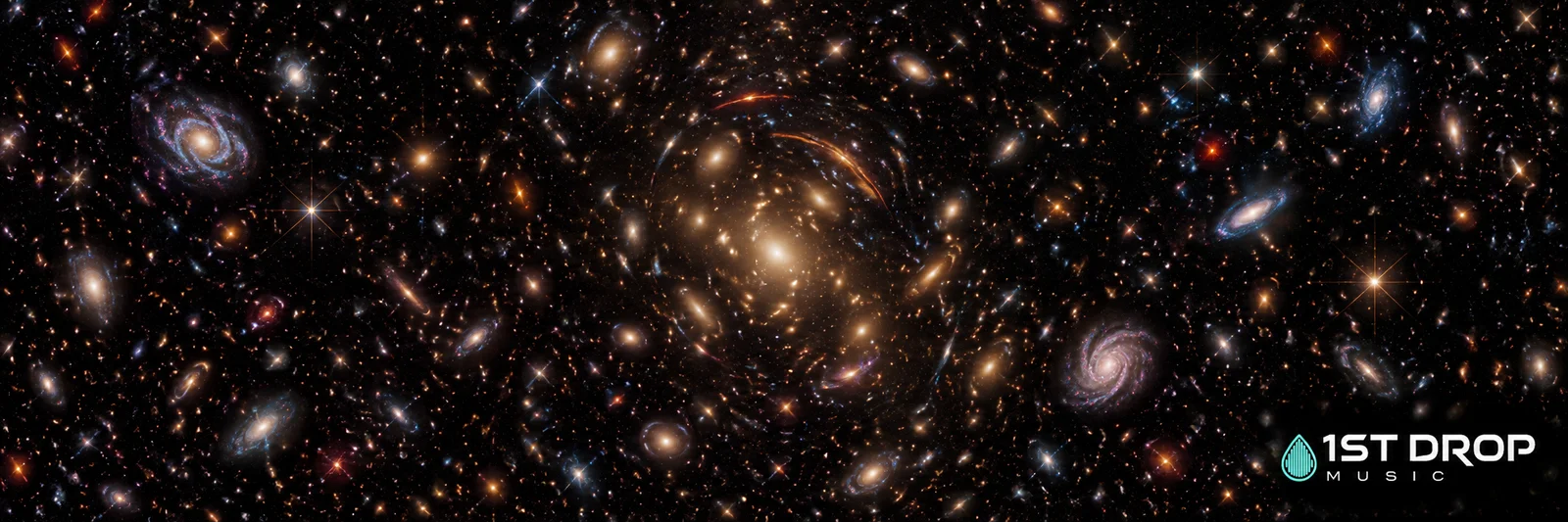
An album can be a group of songs assembled in one place. It can also be something larger: a setting, a system of ideas, and a world listeners can enter from more than one direction.
Bear the Astronot works toward the second possibility.
Across projects including DUST, ARIZONA, Ghost Heart, and Trip the Light Fantastic, an album is not treated merely as a container for recordings. Each project develops its own atmosphere, questions, imagery, emotional logic, and relationship to the larger Bear the Astronot catalog.
The songs remain central, but they are parts of a wider structure.
An Album Begins With a World
Some records begin with a collection of finished songs. Others begin with a place, a feeling, a problem, or a question that is still unfolding.
Bear the Astronot’s work frequently grows from that wider foundation. The identity of a project may emerge through recurring language, visual motifs, production choices, characters, memories, and geography. These elements help determine what belongs inside the album’s world and what should remain outside it.
This approach creates cohesion without requiring every song to sound identical.
A quiet, reflective track and a forceful alternative hip-hop record can occupy the same album when they share an emotional landscape. A project’s unity can come from perspective and purpose rather than from a rigid formula.
That distinction matters in music that moves between hip-hop, electronic production, alternative songwriting, spoken language, experimentation, and cinematic atmosphere.
The Geography Is Larger Than One Landscape
The environments surrounding Bear the Astronot’s music are not limited to a single version of the Southwest.
The story stretches between the ponderosa pines and mountain air of Flagstaff, the scale and silence of Grand Canyon country, the sagebrush and high desert of the Navajo Nation, and the dense urban energy of Phoenix and Tucson. It moves between elevation and heat, winter roads and summer pavement, open distance and crowded rooms.
These places provide more than scenery. They influence rhythm, perspective, memory, contrast, and the way time is experienced.
The Southwest in this music is not a decorative backdrop or an imaginary desert fantasy. It is a lived geography containing mountains, forests, canyons, cities, reservations, highways, neighborhoods, and long stretches of changing terrain.
That range gives each album access to a broader emotional vocabulary.
Songs Can Become Different Entry Points
When an album is built as a world, every song does not have to explain the entire project.
One recording may provide the emotional center. Another may establish a character or conflict. A shorter piece may work like a transmission, memory, scene change, or fragment of internal dialogue. A track that initially appears separate may reveal its role when heard beside later material.
Listeners can enter through whichever song reaches them first.
From there, they can explore more of Bear the Astronot’s music, follow curated listening paths, or watch the accompanying visual work. These are not simply separate content categories. They offer different ways to understand the same creative world.
The complete meaning does not have to arrive during the first listen. It can accumulate.
DUST and the Snowball Album
DUST demonstrates this philosophy through its continuing development as a Snowball Album.
The project was originally released with its first group of songs available, but that release did not mark a conventional endpoint. New work continues to expand the album as it is written, recorded, finished, and released.
The beginnings of DUST are already available. The larger project is still becoming.
That structure allows listeners to encounter the album as a living body of work rather than only as a finished object delivered after every decision has been made. Its history remains visible while its future is still open.
A Snowball Album does not mean releasing material without care. It means recognizing that certain creative ideas are too expansive to be confined to one fixed moment. The album grows as its world becomes clearer and additional songs earn their place within it.
Visual Identity Is Part of the Story
Album artwork, photography, typography, videos, and presentation all affect how a musical project is understood.
For Bear the Astronot, these elements are not intended to replace the music or manufacture a story that the songs do not contain. Their role is to extend the atmosphere already present in the work.
A visual may emphasize scale, isolation, movement, technology, geography, memory, or transformation. A video can reveal another angle on a song without defining its only possible interpretation. Even the organization of a website can help listeners recognize relationships among albums, tracks, playlists, and stories.
This is one reason the broader digital ecosystem matters. Music should not be reduced to a disconnected thumbnail, an isolated streaming link, or a temporary social post.
The artist’s own space can preserve context.
Connected Does Not Mean Closed
Building a world around an album does not require explaining every symbol or controlling every interpretation.
The strongest worlds leave room for listeners.
A lyric can remain unresolved. A recurring image can acquire different meanings over time. A song may connect to a listener’s life in a way the artist never anticipated. The project supplies structure and atmosphere, but the audience completes part of the experience.
That openness is especially important for work concerned with memory, place, personal mythology, technology, identity, and change. These subjects become smaller when they are reduced to one definitive explanation.
Bear the Astronot’s album worlds are designed to hold ambiguity rather than eliminate it.
A Catalog With Memory
Thinking at the album level also changes how a catalog develops.
Each project can have its own identity while remaining connected to the work that came before it. Ideas may return in altered forms. An earlier question may receive a different answer years later. A sound, location, or character can reappear with new meaning.
The catalog begins to remember itself.
That continuity rewards close listeners without requiring newcomers to begin at the beginning. Someone can discover one song today, enter the project through that recording, and gradually find the larger network surrounding it.
The albums remain distinct, but they share an evolving creative history.
More Than a Release Cycle
Modern music platforms often encourage artists to think in isolated moments: release a song, promote it briefly, and move immediately to the next one.
Bear the Astronot’s approach makes room for a longer relationship with the work.
A song can continue to matter after its initial release. An album can expand. A visual can reopen an earlier idea. A new article or playlist can reveal connections that were previously difficult to see. The work does not have to disappear simply because the promotional calendar has advanced.
This approach respects both the time required to make the music and the time listeners may need to fully encounter it.
Enter the Larger Bear the Astronot World
Bear the Astronot builds albums as places to return to—worlds shaped by sound, language, geography, visual identity, and years of connected creative work.
Some are complete statements. Others remain open enough to grow. Each adds another region to an expanding catalog without surrendering its individual identity.
To continue exploring, listen to the music, discover the playlists, watch Bear the Astronot’s videos, or read the full artist story.
Bear the Astronot is part of the independent creative ecosystem developed with 1st Drop Music, where releases, stories, and connected artistic identities can retain the context that gives them meaning.