
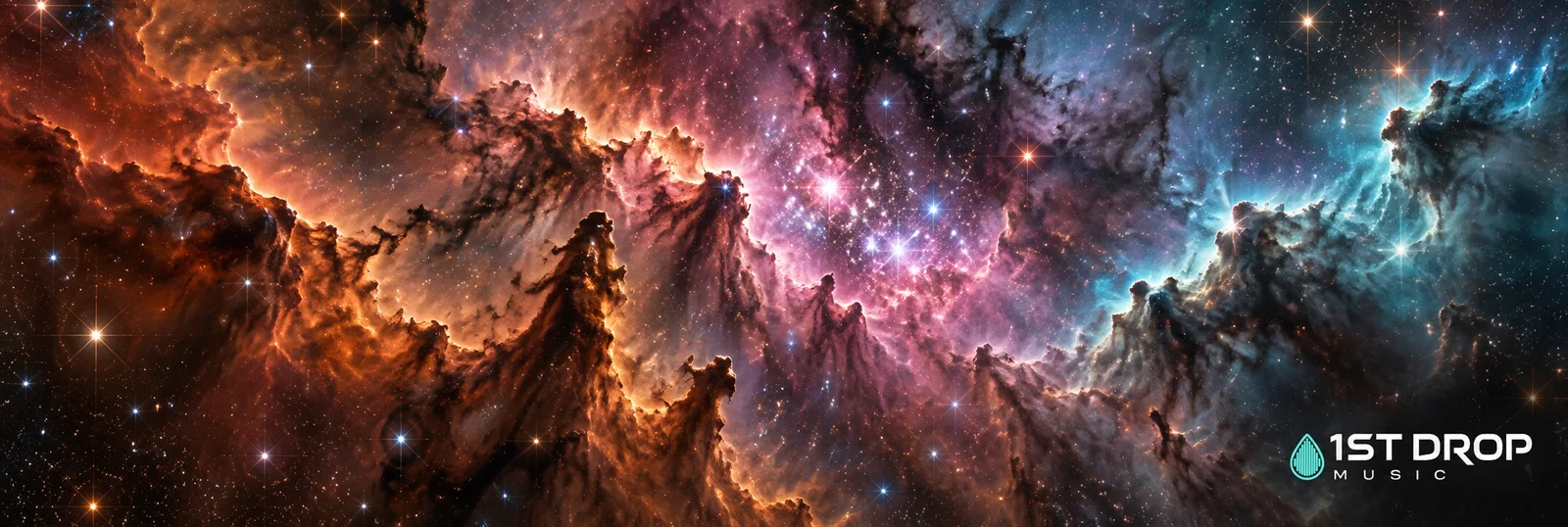
DUST is not a conventional finished album preserved exactly as it appeared on release day. It is a Snowball Album: a growing body of music that listeners can experience while Bear the Astronot continues writing, producing, finishing, and releasing new songs for it.
The beginnings of DUST became publicly available on December 6, 2024. That date marks the first stage of the album’s release—not the end of its creation.
Instead of withholding the entire project until every part is complete, Bear the Astronot is allowing the album to accumulate in public. Its existing songs establish the world. Future additions will deepen it, complicate it, and reveal more of the complete picture.
What Is a Snowball Album?
A Snowball Album begins with a real, listenable foundation and grows over time.
New songs are added as they are completed and released. The album gathers mass, meaning, and context rather than arriving as a single fixed package. Listeners do not merely encounter the final result; they can follow the project through different stages of its development.
The idea reflects how independent music is often created in real life. Writing, recording, production, visual work, distribution, and promotion do not always happen within one clean campaign window. An artist may recognize the larger world of an album before every song inside that world is finished.
The Snowball Album provides a structure for that reality. It makes the creative process part of the release rather than something that must remain hidden until an arbitrary deadline.
The Beginnings of DUST Are Available Now
Listeners can already enter the world of DUST. Its first released material establishes the album’s alternative hip-hop foundation and introduces its central atmosphere.
Mission HQ identifies DUST primarily as alternative hip-hop, with additional connections to experimental music and hip-hop. Those categories locate its musical center without containing everything the project may become.
The album combines lyrical writing, rhythm, electronic atmosphere, tension, space, and cinematic scale. As new songs arrive, those elements can expand in different directions while remaining connected to the same larger body of work.
The available version is not a placeholder. It is the genuine beginning of the album.
Why DUST?
Dust can appear to be what remains after something has disappeared, but it is also evidence that something existed.
It collects. It travels. It settles into machinery, clothing, roads, rooms, and memory. In the Arizona desert, dust is not an abstract poetic device. It becomes part of the physical atmosphere and follows people home.
That makes it a natural organizing image for Bear the Astronot. The project examines what people carry with them: relationships, decisions, ambitions, losses, unfinished work, survival, and former versions of themselves.
Dust also changes with accumulation. A single particle is almost invisible. Over time, many particles alter the appearance of an entire landscape. That process mirrors the Snowball Album itself. Each completed song adds another piece of evidence and another layer of meaning.
A World That Can Continue Expanding
Because DUST is still being completed, its present shape should not be mistaken for its final boundaries.
Themes introduced in one song may return from another angle. A production idea may grow into a larger musical language. New material may change how earlier songs are understood. The album can develop relationships between pieces that did not exist when its first stage became available.
This does not mean the project lacks direction. Growth is the direction.
Bear the Astronot has established the album’s identity while leaving enough space for discovery. The structure provides continuity without forcing every creative decision to be made before listeners hear the first transmission.
Alternative Hip-Hop With a Wide Horizon
The music belongs to hip-hop, but its methods reach beyond a single genre boundary.
Rhythm and lyrical expression remain central. Electronic texture, experimental production, low-end pressure, silence, distortion, melody, and cinematic composition help shape the surrounding environment.
The sounds are not included simply to make the album harder to classify. They serve the emotional needs of the songs.
A close, human voice can exist inside an enormous sonic space. A rhythm can feel grounded while the production surrounding it suggests distance. An intimate subject can be treated with the scale of a landscape.
That tension is part of the Bear the Astronot identity.
Between the Arizona Desert and Outer Space
Two vast environments repeatedly meet within the project: the desert and space.
One is immediate and physical. The other suggests nearly unimaginable distance. Both expose scale. Both can create wonder, isolation, danger, clarity, or silence.
Arizona is not used as generic scenery. It is part of Bear Cole’s lived experience. Heat, long drives, expanding cities, open land, hard light, and enormous night skies affect how the world is perceived.
Space gives those experiences another vocabulary. It allows the artist to create distance from ordinary life without abandoning it. Bear the Astronot does not leave Earth to avoid human problems. He uses the view from farther away to examine them.
A Human Story Inside the Signal
The science-fiction language surrounding Bear the Astronot is a frame rather than a disguise.
At the center of DUST is a human being working through memory, isolation, desire, responsibility, ambition, loss, survival, and the need to continue creating.
The Astronot is not a flawless hero floating beyond consequence. He is an outsider carrying earthly weight into unfamiliar territory.
That distinction keeps the project emotionally grounded. The production may feel cinematic, strange, or enormous, but the songs remain connected to recognizable life.
Why Release an Album Before It Is Finished?
The traditional album cycle asks artists to complete everything privately, release the finished package, promote it for a limited period, and then move on.
That structure can be useful, but it is not the only honest way to make an album.
A Snowball Album gives songs room to arrive when they are ready. It allows listeners to form a relationship with the project during its creation. It also lets an independent artist keep attention connected to a growing body of work rather than treating every new song as an isolated event.
The approach requires clarity. Listeners should know that the music already available is real and intentional while also understanding that the album remains open.
DUST is both an existing release and an active creative process.
Part of the Bear the Astronot Catalog
DUST belongs to a wider catalog that includes albums such as ARIZONA, Ghost Heart, and Trip the Light Fantastic, along with singles including “Gravity,” “Bearcat,” “Jaded Warrior,” “My Songs,” and “Going Down Together.”
These releases reveal different parts of the project’s alternative, experimental, electronic, and hip-hop vocabulary.
DUST is distinct because listeners can follow its continued formation. Its place in the catalog will become clearer and richer as more of the album arrives.
An Independent Album Inside a Larger Ecosystem
Bear the Astronot releases music through 1st Drop Music, an independent ecosystem connecting original productions, artist identities, visual work, playlists, editorial context, and direct relationships with listeners.
That infrastructure helps DUST remain more than a streaming entry. Its songs can stay connected to their artwork, credits, descriptions, stories, and place within the larger catalog.
Technology supports the process, but the creative decisions remain human. The system is being built to preserve the identity and history of the work as the Snowball Album changes.
Enter the Album While It Is Growing
There is no need to wait for the final version of DUST to begin listening.
The available songs are the opening chapters of the album. They establish its atmosphere and provide the foundation upon which future releases will build. Listeners arriving now can experience the project differently from those who discover it after more songs have accumulated.
Explore the current Bear the Astronot catalog at Music, follow connected listening paths through Playlists, and experience the project’s visual work at Videos.
For the story behind Bear the Astronot, visit About. Verified destinations across music and the wider internet are available at Links.
DUST began its public life on December 6, 2024, but it is still moving. The signal is active, the album is growing, and its complete shape has not yet reached the horizon.